 English
 العربية

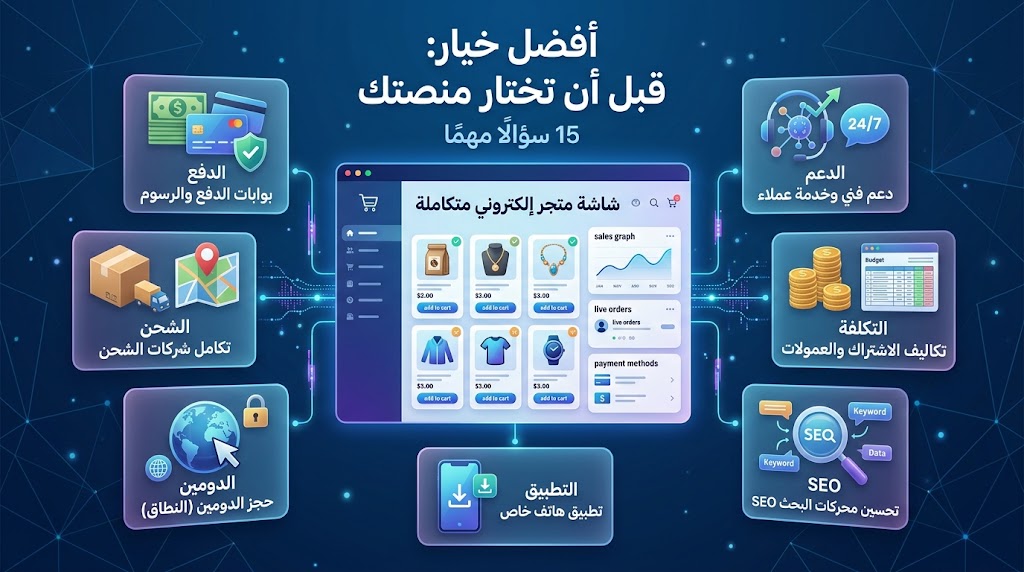
Before choosing your ecommerce platform: 15 questions to ask before you pay.
Choosing an ecommerce platform should not start with the lowest price or the nicest theme. A platform that looks perfect today may become a limitation later when you need better payments, delivery, customization, reporting, or room to grow.
Before subscribing to any platform, use these fifteen questions as a practical checklist. If the answers are clear and fit the way your business operates, you are much closer to making the right decision. If they are not, it is better to know that before moving your products and customers onto the platform.
Don't ask: “What is the best platform?” Ask: “What do I need from the platform?”
A platform that works brilliantly for a merchant in Saudi Arabia may not be the best option for a merchant in Yemen. Likewise, a platform built for a small store with twenty products may not be suitable for a company that needs inventory, POS, mobile apps, analytics, and system integrations.
So do not compare platforms only by the number of features they list. Compare them based on how you actually plan to sell.
What I need today
Payments, delivery, products, order management, and the daily operation of the store.
Current requirementsWhat I may need later
Apps, branches, POS, integrations, analytics, and additional functionality as the business grows.
ScalabilityWhat will the full setup cost?
Not just the subscription, but also apps, payments, development, design, and extra services.
Total costIf you do not know the answer, do not pay yet.
A beautiful pricing page does not always tell you what will happen when you start running the store every day.
Before subscribing, make sure you understand the fundamentals of actually operating the business, not just how the storefront looks.
Does the platform actually fit the country where I sell?
Being able to create an account from your country does not automatically mean the platform is suitable for your market.
Look at what happens after registration. Does it support the payment methods people use locally? Can you work with the delivery companies or couriers available to you? Can you use the currencies your business needs? Does the support team understand your market?
Does the platform support the payment methods my customers actually use?
A great-looking store is not very useful if the customer reaches checkout and cannot find a suitable way to pay.
Before subscribing, write down the payment methods your customers actually use and check whether the platform supports them.
- Cash on delivery.
- Bank transfer.
- Local wallets.
- Online payment gateways.
- The currencies you need to accept.
How will I manage delivery, and can I set different prices by area?
Delivery is often overlooked when launching a store, especially when shipping costs vary between cities or neighborhoods.
Ask whether you can add your own delivery company or courier, define the areas you serve, and assign different delivery prices based on those areas.
How much will the platform really cost me after one year?
One of the worst ways to compare ecommerce platforms is to look only at the monthly subscription price.
Calculate the complete operating cost:
- Subscription fees.
- Domain costs, if separate.
- Add-ons and integrations.
- Mobile apps.
- Payment gateway fees and commissions.
- Themes and design.
- Custom development.
- Marketing or operational services you may need.
Ask instead: Which plan gives me the tools I need without forcing me to pay for a long chain of additional services every month?
Can I use my own domain name?
A domain such as yourstore.com is part of your brand identity, not just a technical detail.
Before choosing a platform, make sure you can connect a custom domain instead of relying permanently on a subdomain owned by the platform.
Will I be able to manage the store easily once orders start coming in?
Launching a store is one thing. Managing it every day is another.
Imagine you are away from your desk and a new order arrives, or you need to update a product or check performance. Does the platform force you to use a desktop computer, or can you keep working while you are on the move?
Does the platform support the type of products I sell?
Not every business sells a physical item that goes into a box and gets shipped.
You may need product variations, inventory management, digital products, direct in-store sales, or printed invoices.
Check for:
- Inventory management.
- Different product types.
- Digital products.
- Offers and promotions.
- Direct sales.
- Invoices.
Will I need a mobile app for the store later?
Not every store needs Android and iPhone apps on day one. But if mobile apps are part of your future plan, understand the options and costs before choosing a platform.
Ask:
- Is a PWA available?
- Can I get an Android app?
- Can I get an iPhone app?
- Is the app managed separately or from the same store dashboard?
- Is app-store publishing included or charged separately?
What if I need to connect the store to another system?
You may not need any integrations during your first month. But as the business grows, you may want to connect the store to an external service, accounting system, app, or another operational workflow.
At that point, platform flexibility becomes more important than the number of themes it offers.
Ask about integrations, APIs, and whether some connections require additional fees.
Can I customize the store, or will I always be limited by the theme?
A ready-made theme is a great starting point. But as your brand grows, you may want to change the layout, create a different experience, or add functionality that is not included in the default design.
Check how much control the platform gives you and whether advanced technical customization is available when needed.
Is the store prepared to appear in Google?
A beautiful design is not enough if search engines cannot properly understand your product and content pages.
Check SEO controls such as page titles, meta descriptions, URLs, product content, performance, and content structure.
If content marketing is part of your strategy, also check whether the platform supports blogging. Good content can attract potential customers before they are ready to buy.
Will I know what is happening inside my store?
Once the store is live, you will need more than simply seeing the number of orders.
As your business grows, data becomes increasingly important for understanding performance and making better decisions. You may want to analyze a specific sales period or export reports for further review.
How do I get support when something goes wrong?
Technical support may not feel important while you are adding your first product, but it becomes critical when you are running an advertising campaign or processing live customer orders.
Do not ask only: “Is support available?” Ask which support channel is included with each plan.
Are there requirements that could prevent me from starting?
Some entrepreneurs are still testing their idea and may not yet have a fully established company or commercial registration.
Before subscribing, check the requirements for creating the account and activating different payment or external services, because the platform's requirements may be different from those of banks or payment providers.
Can the platform grow with me if my business changes?
This may be the most important question on the entire list.
You may begin with a simple online store and later become a company with inventory, branches, apps, custom systems, and much more complex operations.
So do not think only about what is included in today's plan. Also ask whether the provider can help when your requirements become less standard.
Multilingual storefronts are not currently supported as a standard built-in feature. Multi-vendor marketplace functionality is also not currently a native platform feature, although similar solutions can be developed separately as custom projects when required.
Reduce the 15 questions to this decision map.
If you can answer every item clearly, you are ready to compare ecommerce platforms more intelligently.
Does the platform fit the country and customers I target?
Does it support the methods my customers actually use?
Can I control areas, pricing, and couriers?
What will I really pay over a full year?
Can I use a domain that carries my own brand?
Can I run the store easily every day?
Does the platform support the way my business sells?
What happens if I need an app later?
Can the store connect to other systems and services?
Can I go beyond the standard theme when needed?
Does the platform help my content and products become discoverable?
Can I understand performance and export reports?
Who helps me when there is a problem?
Are there conditions that stop me from getting started?
Can I expand without rebuilding everything from scratch?
Don't judge a platform from its homepage.
The best way to know whether an ecommerce platform fits your business is to use it as if your business were already operating.
Tamqin Online provides a one-week trial, so do not use it as a simple dashboard tour.
The right platform should disappear into the background while your business runs.
The purpose of an ecommerce platform is not to become the center of your business. Its job is to make operations easier so you can focus on products, customers, and sales.
If you find yourself searching for a workaround every week because of the platform itself, that is a warning sign worth paying attention to.
Before subscribing, return to the fifteen questions and ask yourself:
- Does the platform fit the market where I sell?
- Does it make daily selling easier?
- Do I understand its true cost?
- Can I grow with it?
- Will I get the support I need when the store becomes a serious part of my business?
You do not need to decide based on this article.
Use the one-week trial. Add your real products, configure your payments and delivery, test an order, and open the store from a customer's phone.
After that, you will know more than any feature page can tell you.
If you are still choosing your platform.
Before choosing your ecommerce platform.
Short answers to common questions business owners ask before subscribing.
How do I choose an ecommerce platform?
Start by defining your target market, payment methods, delivery model, and product types. Then compare total cost, ease of management, customization, scalability, SEO, and support instead of comparing platforms only by feature count.
What is the most important thing to check before choosing an ecommerce platform?
There is no single factor for every business, but payments, delivery, total cost, and scalability are among the most important things to verify before moving your business onto a platform.
Should I choose the cheapest ecommerce platform?
Not necessarily. A platform with a low subscription fee may become more expensive once you add apps, integrations, payment services, and other functionality your business needs. Compare the full annual cost.
Do I need a custom domain for my online store?
A custom domain is strongly recommended because it gives your business an independent, professional web address and helps build your brand over the long term.
Do I need a mobile app when launching my store?
Not necessarily. You can begin with a mobile-friendly storefront or PWA, then evaluate the need for dedicated Android and iPhone apps based on customer behavior and repeat usage.
Can I create an online store without a commercial registration?
It depends on the platform and services you use. Tamqin Online does not require a commercial registration simply to create the store itself, although payment providers and external services may have their own requirements.
Can I try Tamqin before subscribing?
Yes. Tamqin offers a one-week trial that allows you to create your store, add products, and explore the management experience before deciding whether to subscribe.
Does Tamqin support multilingual stores?
Multilingual storefronts are not currently supported as a standard built-in feature, so if multiple storefront languages are a core requirement, this should be considered before choosing the platform.
One week of testing can save you from the wrong platform for years.
Create a trial store on Tamqin Online, add real products, test payments, delivery, and daily management, then decide based on actual experience.
Start Your Free Trial →
Add New Comment